
Assessment Should See the Whole Child, Not Just the Paper
Some children read a new lesson without a mistake; others underlined the words they could not yet pronounce. Our Director, Engineer Maulana Irfan Ali, on why activity-based learning and self-assessment help every child see their strengths and next steps.
By Director, Engineer Maulana Irfan Ali, Ameen Islamic Institute.
A classroom lesson, and a different way of measuring progress
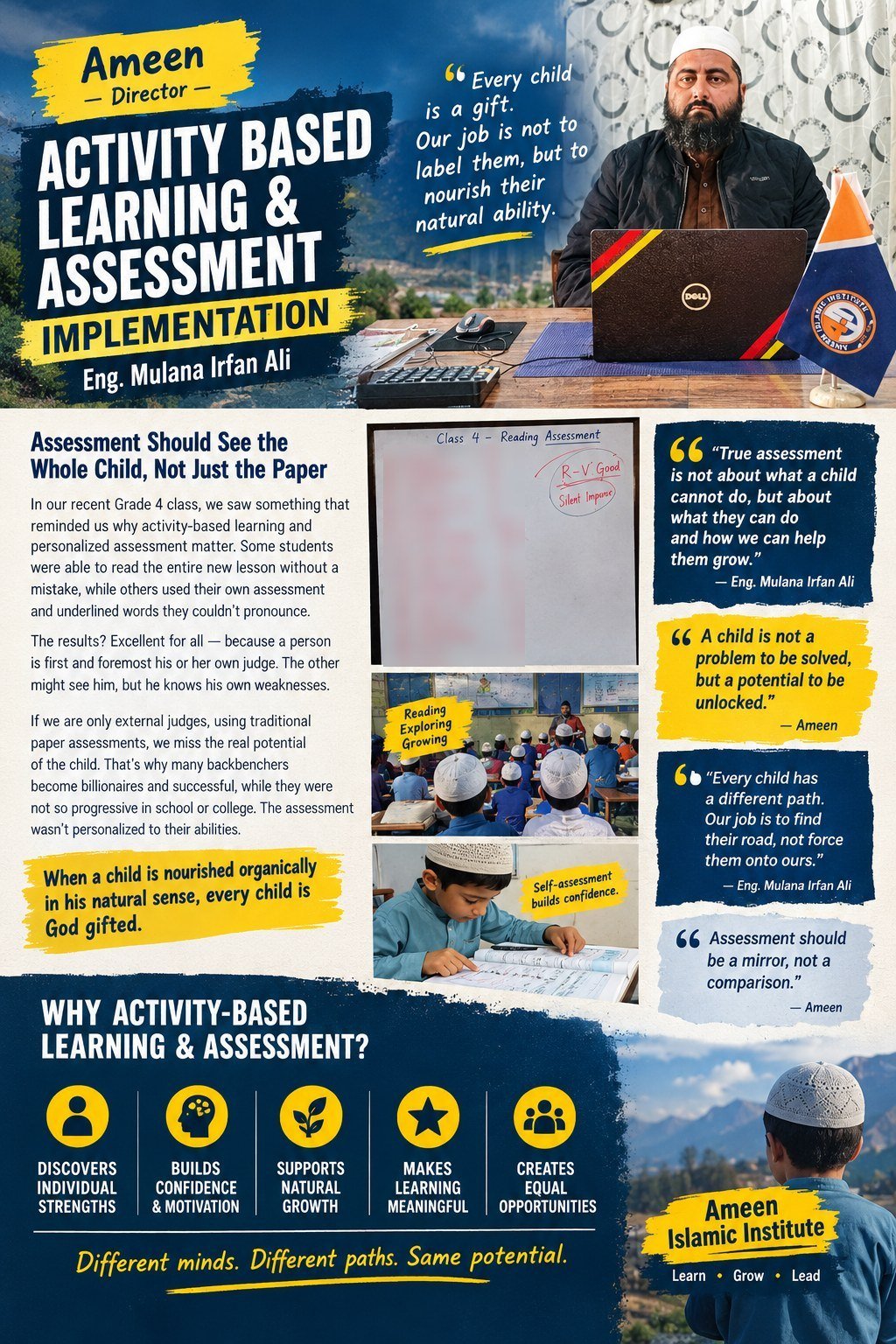
In a Grade Four classroom at Ameen Islamic Institute, a reading activity offered a useful reminder: children do not all learn, struggle or demonstrate progress in the same way. Some students read an entire new lesson without making a mistake. Others stopped at unfamiliar words, underlined the words they could not pronounce and identified the areas where they needed more practice.
The child is also an assessor
The most important part of this activity was not simply whether every word was pronounced correctly. It was that students were encouraged to observe their own performance. A learner who can say, “I know this part, but I need to practise that word,” is beginning to develop self-awareness and responsibility for learning.
A teacher sees a child from the outside: the answer, the reading, the written work and the performance on a particular day. The child, however, has direct experience of where understanding feels secure and where it begins to break down. When students are supported in expressing that knowledge, assessment becomes a conversation rather than a verdict.
“Assessment should be a mirror, not a comparison.”
Why one test cannot tell the whole story
Traditional paper-based assessments can measure important things: recall, comprehension, accuracy and the ability to apply knowledge under specific conditions. The problem begins when one result is treated as a complete description of a child’s ability or future potential.
A student may be quiet in class but capable of careful independent work. Another may understand a concept through discussion or practical activity before being able to express it confidently in writing. A learner who struggles with one task may excel in another. If assessment repeatedly rewards only one way of demonstrating understanding, it risks confusing performance in a particular format with a child’s overall capacity.
Activity-based learning makes understanding visible
Activity-based learning gives students opportunities to demonstrate knowledge through doing, speaking, reading, explaining, making, collaborating and reflecting. In a reading lesson, that may mean reading aloud, marking unfamiliar words, practising pronunciation with a partner and returning to the same passage to notice improvement. In another subject, it might involve a demonstration, a model, a group task or explaining a solution in the student’s own words.
Personalised assessment is not about lowering standards or praising every answer as correct. It is about keeping the learning goal clear while recognising that students may need different routes, different amounts of practice and different kinds of feedback to reach it.
“A child is not a problem to be solved, but a potential to be unlocked.”
From judgement to useful feedback
The practical question for a teacher is not only, “Who scored highest?” It is also, “What has each student learned, what remains difficult, and what should happen next?” A useful assessment connects evidence to action.
For the student who reads fluently, the next step might be expression, comprehension or explaining the meaning of the passage. For the student who underlines unfamiliar words, it might be guided pronunciation practice and another opportunity to read. Both students can progress, but they may not need the same intervention.
Ameen Islamic Institute’s emphasis on activity-based learning and assessment can build a classroom culture in which students are taught to notice their progress without being ashamed of their difficulties. Errors become information. Feedback becomes direction. Progress is measured not only by comparison with classmates, but also by the distance a learner has travelled from their own starting point.
Every child has potential; teaching must help it grow
No single method can identify every strength, and no child should be reduced to a label such as “weak,” “bright” or “backbencher.” Children need structure, encouragement, meaningful expectations and adults who are willing to look again when a first assessment does not tell the whole story.
The role of education is not to pretend that every child is the same. It is to help each child develop the abilities they have, strengthen the areas that need work and discover new capacities through experience. When a learner can recognise a weakness and accept that it can be improved, assessment has already begun to serve its real purpose.
Every child is God-gifted in a way that deserves care and opportunity. Our responsibility is to create the conditions in which that potential can be discovered, guided and developed, not to assume that one score, one test or one moment can define a whole person.
“Different learners may need different routes. The goal is growth, not a label.”
A simple classroom cycle
- Observe: Give students a meaningful task and notice how they approach it.
- Reflect: Ask learners to identify what they can do and what remains difficult.
- Respond: Offer targeted feedback, practice or a suitable next challenge.
- Review: Return to the task and help students recognise their progress.