Knowing the Whole Child: How We Are Building a Learning Profile for Every Student
A report card tells a parent what a child scored. This term we are beginning to see the whole child, through six dimensions, small daily habits and a one-page profile that starts with strengths.
A report card tells a parent what a child scored. It rarely says how that child feels about school, how she handles frustration, whether he is kind to his classmates, or whether either of them is growing in confidence. At Ameen Islamic Institute, we believe those questions matter as much as marks, and this term we are beginning to answer them in a structured, careful way.
Why this is necessary
Children do not learn in pieces. A student who is anxious cannot concentrate. A student who does not feel she belongs stops asking questions. A student who has never been trusted with responsibility rarely learns to carry it. Yet most schools measure one thing, academic performance, and leave everything else to chance.
For an Islamic institution the gap is sharper. Our tradition has always cared for the whole person: body, heart, character and mind. Cleanliness is part of faith, truthfulness is a duty, and seeking knowledge is an obligation. A school that inherits this tradition should be able to show how it nurtures all of these, and not merely claim that it does.
How we adopted it
We began by asking how other schools approach the problem. Japanese schools make hygiene and responsibility daily habits by having students serve lunch and clean their own classrooms. Finland weaves health education and time outdoors into the school day. Schools following the International Baccalaureate expect service, activity and creativity alongside study, and social and emotional learning programmes teach children to name and manage their feelings.
We then needed a structure of our own. We chose the six dimensions of the Self Concept Questionnaire developed by Dr. Raj Kumar Saraswat: physical, social, temperamental, educational, moral and intellectual. Each describes how a child sees herself or himself in one part of life. The educational dimension was already in place, and the physical dimension is partly covered by the karate and yoga our students already practise. The rest we are now building for our pre-primary and primary students.
How it works
Every dimension has a daily habit, a term activity and a way of noticing growth.
- Physical: hygiene routines, shared care of the classroom, karate and yoga, and our Safe and Strong and Growing Up Well courses for girls.
- Social: a buddy system that pairs older and younger students, and a class service project.
- Temperamental: a morning check-in in which children name how they feel, and a calm corner in each classroom.
- Educational: our phonics trainer, and a portfolio that gathers each child’s best work.
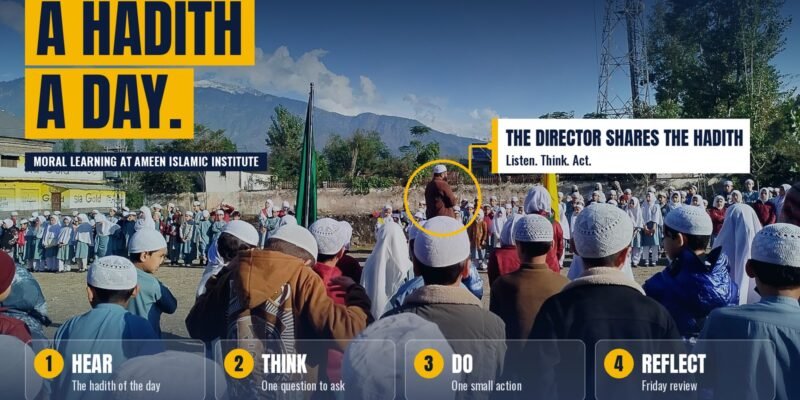
- Moral: a hadith or thought for every day, which the class hears, thinks about, puts into one small action, and reflects on at the end of the week.
- Intellectual: a game-based “Truth Detectives” lab. Older pupils play an online game for ages 8 to 11, made by the Dutch organisation DROG with researchers at the University of Cambridge, that shows how fake news is made. Then they practise a simple habit: stop, check, and verify before sharing. It echoes the Qur’anic instruction to verify news before acting on it.
Every student also holds a role, such as hygiene monitor, buddy or calm-corner keeper, so that each child carries real responsibility.
How we notice growth
Profiling here is not a single test. At the start of term we take a baseline, using short pictorial self-concept questions read aloud by the teacher, alongside teachers’ observations. Through the term, teachers keep short notes, and children build portfolios and simple reflections. At the end we repeat the process and sit down with each student and guardian, to talk and not to rank. Every child receives a one-page profile that begins with their strengths and sets out one or two next steps.
We hold to firm rules. Guardians give written consent before any profiling begins. Scores are never displayed or compared between children. A low result is a reason for a conversation, never a label. Student data stays inside the Institute, and anything we publish is anonymised.
What we expect
This is a pilot, and we want to be honest about what it can show. Over the first eight weeks we expect to establish a baseline for each participating student, to put the daily routines in place, and to learn what works and what does not. Real change in how a child sees herself or himself takes longer, so the first meaningful comparison will come at the end of the term.
What we hope to see over time is children who are healthier in their habits, more confident, kinder to one another, calmer under pressure, more truthful, and more careful about what they believe and pass on. We will report what we find, including what does not work.
Looking ahead
We see this work as a partnership. Parents know their children best, and the profile is most useful when families help shape it. If you would like to understand more about how it works, or what it means for your child, please speak to your child’s teacher or visit the Institute office. We will share updates on this website as the pilot progresses.