
Thinking About Thinking: Why the Best Thing a School Can Teach a Child Is How to Learn
Ask a child what they learned and you hear topics; ask how they learned it and there is often silence. Our Director, Engineer Maulana Irfan Ali, on metacognition: helping children notice how they learn and what they will do better next time.

By Director, Engineer Maulana Irfan Ali, Ameen Islamic Institute.
Ask a child what they learned today and you will usually hear a list of topics. Ask how they learned it, which part was hard, and how they knew they understood, and you may be met with silence.
That silence is the gap this article is about. Education is not only about handing children information or preparing them for examinations. It is about helping them think, understand, learn from their mistakes and improve their own abilities. The tool for that is called metacognition.
The big idea
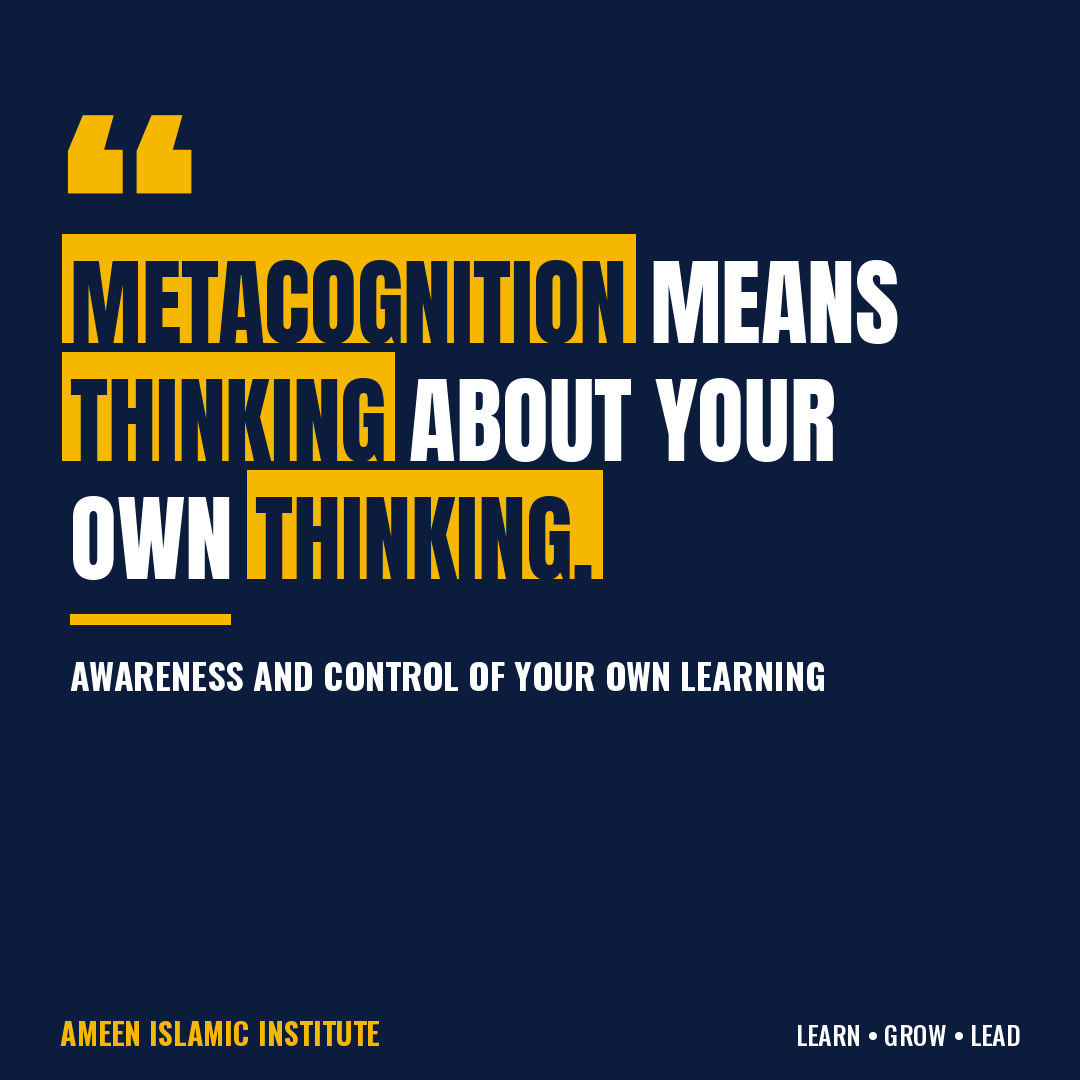
What is metacognition? Thinking about your own thinking. Awareness and control of your own learning.
Researchers describe metacognition as awareness and control for learning (Cross and Paris, 1988). A learner notices what he understands and what he does not, plans how to learn, checks whether the plan is working, and changes it when it is not. The term is closely associated with the psychologist John Flavell. In plain words, it is learning how to learn.
It starts with knowing yourself
Good thinking begins with what a learner knows about himself: his strengths, his weak points, how confident he is in his own ability (self-efficacy) and how he values himself (self-esteem). Course material on the subject divides this knowledge into three parts:
- Person: what I know about myself as a learner.
- Task: what this task demands, and how hard it is.
- Strategy: the best way for me to do it.
Put together, they sound like this: “I find science harder than English (person). The science homework will take longer (task). So I will do it first, while I am fresh (strategy).” The example is adapted from the educational psychologist Jeanne Ormrod. A child who can say this is already managing his own learning.
Six questions a thinking learner asks
- Did I understand what I just read, heard or saw?
- Which part is hard for me?
- Where can I get help or more information?
- How much time will I need?
- How will I know if I am learning at the right pace, and how can I spot my own mistake?
- If my plan is not working, what will I change?
Novice learners and expert learners
The difference between a struggling learner and a strong one is often not intelligence. It is the habit of thinking about how they learn.
| Novice learner | Expert learner | |
|---|---|---|
| Solving a problem | Rushes to a quick answer | First understands the problem and its limits |
| Choosing a method | Uses one rigid method every time | Picks or designs a method to fit the task |
| Handling information | Tries to take in everything | Selects what matters and breaks it into small parts |
| Checking work | Rarely looks back at the quality | Checks for errors and corrects course |
A gap we cannot ignore
In my view, the problem begins early. When children in school are not nurtured properly, they reach university with little awareness of their own thinking. They can memorise, but they cannot say how they study, or why a method failed.
The research is encouraging on this point. Awareness of one’s own learning is already visible in children as young as eight. The capacity is there. The challenge for schools is to build it, with activities that help students reflect on themselves as learners, on their tasks and on the strategies they use.
There is a deeper reason for this, and it is about character. Think of peer pressure and conformity. When those around us are doing something wrong, a student who never stops to examine his own thinking simply follows, and may land in trouble. A student who has learned to ask ‘Why am I doing this?’ has a protection that no rule can give him. Metacognition is therefore not only an academic skill. It is a guard for the mind.
What this looks like in the classroom
- State the goal. Tell students what they will learn by the end of the lesson and how they will check their understanding.
- Ask ‘how’, not only ‘what’. Besides the right answer, ask how the child reached it.
- Build in self-assessment. Let students name their strengths and the points that need more practice.
- Give constructive feedback. A mistake is not just a failure. It shows what needs to improve, and guidance should be clear and fit the child.
- Reflect on our own teaching. Teachers should ask which methods help students understand, and where a change is needed.
Students can also keep a simple learning record with three lines: what I learned today, what was difficult, and what I will focus on next.
From our own classroom
In a recent Grade 4 reading activity at Ameen, a teacher gave pupils a new chapter and asked them to read it and underline for themselves any word they could not pronounce or read. Some read the whole lesson without a mistake. Others underlined words they were unsure of, and the activity made their reading visible to them and to the teacher.
It also taught a lesson about metacognition. One pupil underlined only two words, yet mispronounced much of the chapter, and went on reading smoothly because he believed he was right. He did not know what he did not know. Self-assessment is powerful, because a learner is the first judge of his own work. But it grows stronger when a teacher listens as well. The child’s own judgement and the teacher’s feedback together turn awareness into accuracy.

What teachers say
“I truly appreciate this thoughtful article because it reflects what I believe about teaching and learning. As an educator, I feel that every child deserves to be understood, encouraged, and valued beyond their marks. Every child has unique abilities, emotions, and learning needs, and it is our responsibility to recognise and nurture them. This article reminds me that our role is not just to assess children, but to understand them, support their growth, and help them become confident learners. A beautiful and meaningful message for every teacher!”
Rushda Rehman, Teacher, Ameen Islamic Institute
A task for the whole school
Promoting metacognition is not the job of one teacher. School leadership shapes an environment where reflection, constructive feedback and continuous improvement are valued. Schools can create time for teachers to exchange ideas, review their lessons and discuss students’ needs together. The aim is not only to point out weaknesses but to understand their causes and agree on steps that can be taken.
Where improvement begins
Metacognition reminds us that learning is not only remembering information. It is testing our understanding, recognising our difficulties and choosing a better way. An effective school does not only prepare students for examinations. It enables them to understand their own learning, take responsibility for it, and keep learning for life.
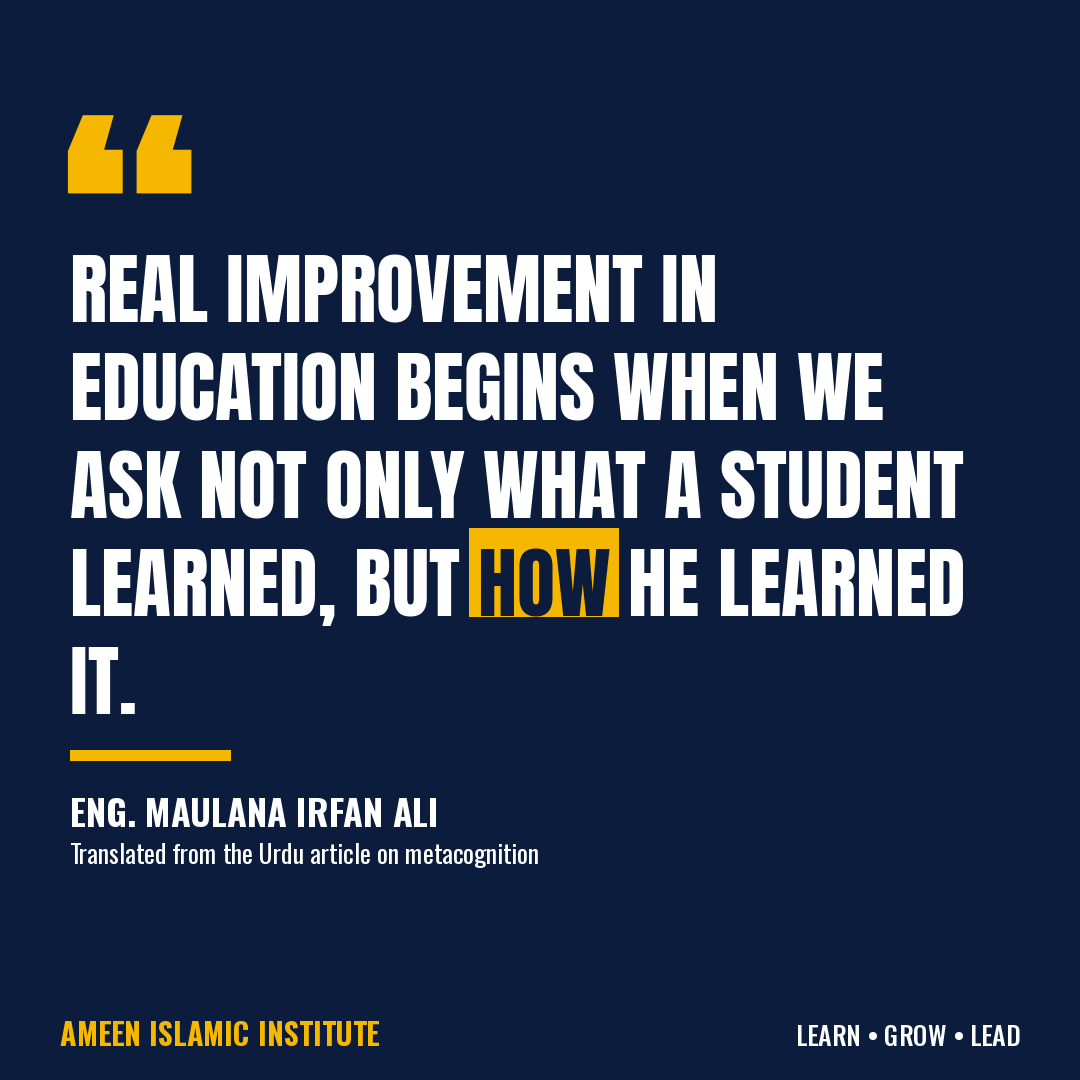
Real improvement begins when we stop asking only what a student learned, and start asking how he learned it, and how he can learn better.
About the author. Engineer Maulana Irfan Ali is the Director of Ameen Islamic Institute. His MPhil research explores the relationship between metacognitive frameworks and educational practices in higher educational institutions.
Sources: course slides on metacognition based on Lucas and Corpuz, Facilitating Learning: A Metacognitive Process (4th ed.), which cite Flavell, Ormrod, Huitt, Fang and Cox, and Houle; Cross and Paris (1988).


A small request to parents after reading this: tonight, instead of “What did you learn today?”, try “Which part was hard, and what helped you?” Share in the comments what your child said. We’ll use your answers in our next teacher workshop.